what figures went to opera stage pollypockets 1993
T hither was a weird interregnum on Coronation Street in 1984. Bernard Youens, the player who had played Stan Ogden for three decades, died. Just the grapheme he played hadn't yet been written out. So Stan carried on regardless, unseen merely living, while millions of the show's fans who had read Youens' obituaries knew the truth: the large lug was on borrowed time.
But how and when would the boozy, workshy, adorable slob who had spent 30 years twice a week in millions of British living rooms become? For several episodes his wife Hilda said Stan was ill in bed upstairs at no 13. How we, on the other end of the cathode ray tube, rolled our eyes.
Then, one night in Nov, Hilda revealed to the nation that her husband had died in his sleep. Solitary in her living room, she took her husband's spectacles from their instance and unfolded them 1 last time. How we, dragged from mere eye-rolling pessimism into the dark heart of crying-time TV, sobbed.
Perchance the strange death of Stan Ogden is a metaphor for the British soap opera 2013. We are in a similarly weird interregnum, knowing that Coronation Street, EastEnders, Hollyoaks, Emmerdale and even the longest-running soap in broadcast history, The Archers, are no longer fit for purpose and are waiting for the how and when they get rubbed out.
TV history is littered with the corpses of terminated soaps – Crossroads, Eldorado, Triangle (how could a soap on a North Body of water ferry not piece of work?), Family unit Affairs and Brookside. Now, the whole genre seems spent. Traditional soaps' ratings are calamitously down: in 2010, Corrie could still pull an audience of more than 14 meg. Today, information technology struggles to achieve half that. EastEnders, meanwhile, has been repeatedly beaten in the ratings by Emmerdale – a shocking fact to those used to EastEnders and Corrie perennially vying for the crown of soapland. The almost talked nearly storylines involve the actors rather than the characters they play: Coronation Street's William Roache, who faces charges of rape, and Michael Le Vell , who has been acquitted of rape charges, non to mention Chris Fountain's outing as a misogynist amateur rapper on YouTube.
If Danny Dyer being roped in to become landlord of the Queen Vic is the solution, then British soap'southward problems are worse than we idea.
Soaps are like printed newspapers or the British monarchy – the just question is when they will do the equivalent of stopping the presses or making the last royal hanger-on live without taxpayer subsidy in a council flat.
Twenty-5 years ago, soap operas were delivery systems for melodrama, cliffhangers, women'south issues, comedy and social critique, and, best of all, white-knuckle rides on the narrative express. Now? "Soaps are now just seen as something to fill up the schedules," says Phil Redmond, the Goggle box producer who brought u.s.a. Brookside and Hollyoaks. "There's been a loss of vision."
In the early on 80s, the most popular soaps – Crossroads and Coronation Street – lost the plot: they had nothing to say about a Britain mired in Thatcher'south austerity years. And then, Brookside (1982-2003), set in a Liverpool suburb, and later EastEnders (1985-present), set in a fictionalised east London, gave the British soap a new lease of life by returning the genre to its manifest destiny: right down to the specially built cul-de-sac in suburban Merseyside and the fake-East Terminate Albert Square in Hertfordshire, the new soaps were simulacra that told us about how we really lived. Brookside was, at the time, especially radical since it junked that staple notion of the British lather, that the action must revolve effectually the local pub. Instead, it depicted an all-also-recognisable, fragmented possessor-occupying non-society of the kind for which the then prime minister proselytised.
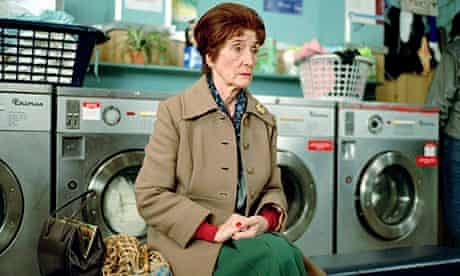
"With Brookie, nosotros were focusing on the deconstruction of guild through the intervention of technology," says Redmond. "Now we're witnessing the deconstruction of society through junk banking – it's merely the soaps have nothing to say about it. Information technology's frustrating – there's so much to say virtually issues like ageing, the influx of different cultures, class tensions. They're losing their souls and, inevitably, ratings."
Of course, soaps have inappreciably been popular because they have their finger on the pulse of the nation. In their heyday, they were immersive experiences that took their own sweet time developing stories and characters, and thereby made themselves convincing and seductive to mass audiences. "People witter on about The Wire and Mad Men," says soap opera specialist Professor Christine Geraghty of the University of Glasgow. "It drives me mad. British soaps were doing those complicated multi-layered narratives long before HBO was invented. Soaps used to have the confidence to permit very little happen sometimes."
Soaps, then, were like Greek drama. What was of import was not splashy plot twists – exist information technology auto crash, baby swap, lesbian snog or corpse under the patio – simply how characters candy such incidents through the medium of gossip. "They don't have the conviction to do that now," says Geraghty. "There's a relentless intensity of plotting that makes soaps often seem daft." Why are they doing that? "Because the big stories capture the intermittent viewer, often at the expense of the regular viewer. The logic is that the more stories yous take and the bigger they are, the better y'all compete with other formats. But that relentlessness eats up people and stories in an effort to counteract what's going on elsewhere in TV. The risk is they await soulless and cynical. It'due south also a vexed question as to whether those large stories help ratings in the long run."
But what is going on elsewhere in Tv set? I cardinal development is the ascent of reality Television. When Big Blood brother was launched on Channel 4 in 2000, it may have been conceived every bit a niche sociological experiment tracking what happened when a group of strangers were locked in a business firm in Hertfordshire; but it became the defining genre of our age, plundered and bastardised, incessantly mutating until nothing real, cipher simply fatuous incident is tolerable. Faced with this mutant television receiver genre masquerading equally reality, soaps have go unreal simply when we needed them to be otherwise. In particular, that about perverse mutation in the genre, the scripted reality prove, has been aped by the worst soaps. In a give-and-take: Hollyoaks has get Geordie Shore and The But Mode Is Essex – as unreal as its purported reality bear witness counterparts.
Traditional soaps at present look like British Leyland in the 70s faced with the looming German language motorcar invasion. Out-thought, outperformed and underdone. None of this would affair much so long equally our existing soaps were running smoothly. But they are not. The leading ones are in crunch at the very moment they need to be at the top of their game.
That failure of nerve is evident on EastEnders, whose last executive producer has quit after but sixteen months in the mail service. Yes, Lorraine Newman won Baftas for the testify during her oddly brief tenure simply she as well presided over i of the soap'due south near disastrous ratings debacles since its inception. Newman wouldn't speak to the Guardian, but one ex-EastEnders producer who declined to be named said: "The pressures on writers to evangelize big stories and on producers to deliver ratings are more intense and more unreasonable than ever. No wonder she went. It's a poisoned chalice if e'er there was 1. A lot of people are now hoping that her replacement [Dominic Treadwell-Collins, a one-time story producer who left EastEnders three years ago] can steady the ship – whatever that ways."
Where did EastEnders go wrong? "If you're request me if at that place was a story or a character that tipped EastEnders over from beingness sensible to featherbrained, I don't recollect I could give y'all an answer. But certainly some characters have become more pantomimey than we would have stooped to make them in the early on days. Kat and Alfie, for example, have become more lurid and their stories more unconvincing to my heed."
EastEnders was one time watched by more than half of the British population. Yep, you lot say, but 1986 had a very different telly ecology, compared with that of today. There were merely four channels then. But today's soaps are no longer nationally unifying entertainments. Instead they are niche formats competing against each other for dwindling demographics.
Soaps ruled during the era of terrestrial channels, not the audience-fractured, multi-channel, on-demand, increasingly net-based viewing milieu nosotros take had since the millennium. Only here is the corollary of that argument: in one case it would take mattered if soaps died. They were so popular that what happened in Albert Foursquare or Brookside Close could provoke questions in parliament; today they are then marginal to British TV and national life that it is hard to imagine that happening once more.
But if things are bad in Walford, they are worse in Weatherfield. While EastEnders is slowly fading into irrelevance, Coronation Street is raging confronting the dying of its lite. The latter'south master problem is that its best narratives aren't the ones that spool from scriptwriters' laptops but the ones howled in caps-lock hysteria from the red tops. Stars accept been caught tweeting almost useless beauty products given to them past a bogus visitor. Producers accept been mired in bizarre product placement rows. Morale is reportedly low on set. In such promisingly dismal circumstances, the Daily Post dispatched a journalist to notice that something was rotten in the state of Weatherfield. "Fans are ditching the soap in their millions," Christopher Stevens duly reported. "Almost half its audience has switched off in the past iii years."
Significantly, Coronation Street was born in 1960 in the aftermath of the kitchen-sink revolution in British drama and during the rise of British movie theater's social realist new wave. "That'southward true," says Geraghty, "but even when Coronation Street was launched, it was, for all its claims to realism, self-consciously recreating a Britain that was on its way out – where the social hub was the pub, for instance." Reality on British soaps has to some extent always been a fantasy.
By the mid-1980s, the British soap tackled social problems – racism, sexism, industrial collapse, class politics, HIV, violence against women, child abuse, cot death, Downwards's syndrome – in ways scarcely conceivable beyond the Atlantic.
Simply not for long. I call back one of Brookside'south leading writers, Jimmy McGovern, telling me in 1996 how the problem for the show began when, as he put it, "inflation set in". More episodes per calendar week, more than focus on ratings, more than need for loftier-octane and oftentimes implausible storylines.
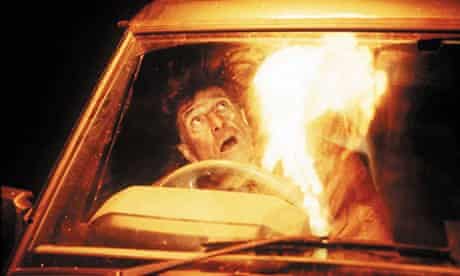
If 1 moment demonstrates how the British soap sold its soul for ratings, information technology is the 1993 Christmas special of Emmerdale. In this episode a plane crashed into Beckindale, previously a place of safely grazing sheep and whiskery Yorkshiremen supping pints.
What happened to social and political relevance? Nowadays, when a British soap tackles a social event, more oftentimes than non information technology does so ineptly. Have the contempo racism storyline in Coronation Street. During a darts game at the Rovers, a white graphic symbol, firefighter Paul Kershaw (Tony Hirst) said: "Play the white human!" to Steve McDonald (Simon Gregson), at the very moment a blackness character, cabbie Lloyd Mullaney (Craig Charles) came into the pub.
Lloyd called Paul a racist, about of the overwhelmingly white pub'south customers agreed, only Paul refused to apologise, saying the remark was not a slur. The story went on for – customary heart curl – ages earlier Paul eventually apologised properly. "I think it'south one of those modernistic stories that will get everyone talking," said producer Stuart Blackburn at the fourth dimension. Information technology did, but non as Blackburn intended: it got many of us wondering if Corrie really had a handle on what racism is and, more importantly, despair over its writers' abililty to dramatise the issue.
Remaining hardcore fans doubtless promise traditional soaps are not on the way out. But they are a conservative bunch. Typical of the resistance to change is the furore over ex-EastEnders producer John Yorke's stewardship of The Archers. The Radio 4 drama is now being attacked for losing its rustic soul à la Emmerdale.
It is clear that traditional soap operas must reinvent themselves. But how? "The mass lather is over," says Redmond. "Y'all'll never become a family to sit down together and watch the aforementioned matter. That said, you might get the parents watching the flat screen, the kids on their tablets , and the teenagers watching on their phones."
"Broadcasters aren't thinking creatively," says Redmond. "They should forget about mass-audience soaps and have an over-55 soap. That'due south where the money and viewers are."
So, is the future for soaps actually so bleak? "They're not what they were but I don't think soaps will wither away," says Geraghty. Only if they did, would it affair? "Of course it would! They have traditionally been seedbeds for talent – for the great writers, directors and actors of tomorrow. Without soaps a great deal of the all-time of British TV simply wouldn't be, so we need to nurture them." Whether they will be remains to exist seen.
Source: https://www.theguardian.com/tv-and-radio/2013/oct/01/soap-operas-has-the-bubble-burst
0 Response to "what figures went to opera stage pollypockets 1993"
Post a Comment