Do Grand Pianos and Baby Grand Pianos Have a Brass Plate Inside
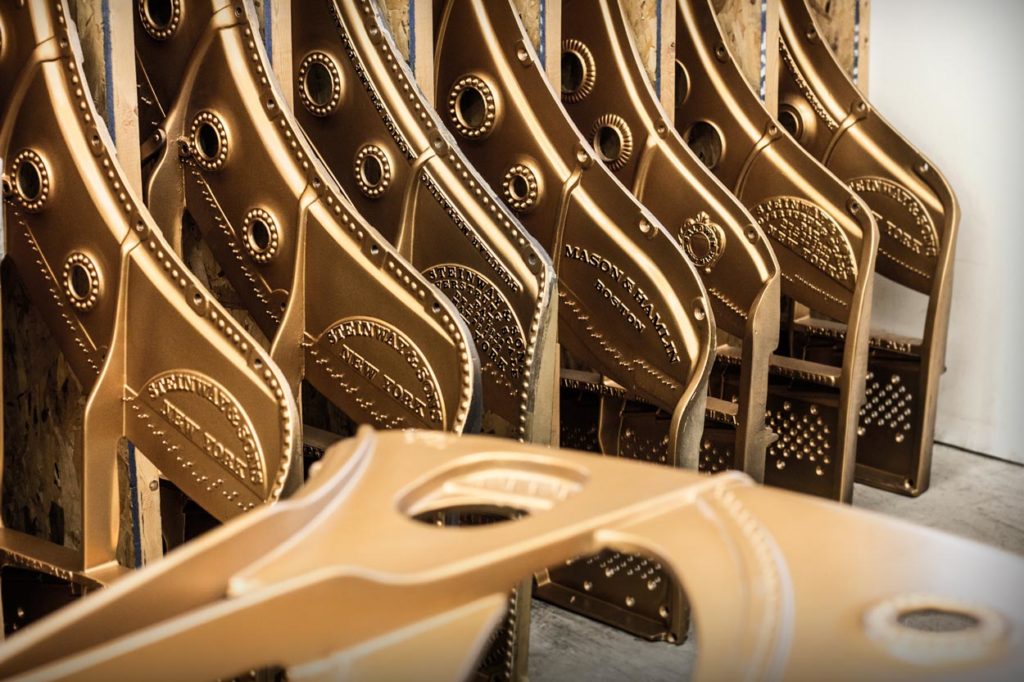
Steinway, Baldwin and Mason & Hamlin Pianoforte Plates
The Pianoforte Plate
The cast iron plate is the single heaviest slice in a piano. Traditionally painted in a golden statuary color, it is one of the most visually striking components of any thousand piano. The plate's function goes beyond the cosmetic. A carefully cast frame, this large piece of bandage iron sits above the soundboard. Its purpose is to blot the lion'southward share of the over 40,000 lbs of tension produced from the hundreds of piano strings. Early pianos lacked iron frames and therefore were unable to support loftier string tension. The introduction of cast fe frames helped transform the piano into the powerful instrument we know today.
Steinway Plates
About oftentimes made of cast atomic number 26, each manufacturer has its own special metal blended for their piano plates. Steinway & Sons uses Class xxx gray iron, a particular combination of metals unique to Steinway. The O.S. Kelly Foundry in Cincinnati, Ohio has made plates for Steinway & Sons since 1938 and is at present their only North American supplier. The Foundry casts thousands of plates each year for the company's New York built pianos – each one completed utilizing fourth dimension-honed, labor-intensive methods.
"It'southward similar a hole-and-corner recipe for manufacturers. They carefully guard their detail (mixes) considering limerick of the plate actually affects the tone of the piano." – Daniel Chupp
Only years of research provide just the right mix of materials. This is of import because the composition not only affects the strength of the plate but the tone of the piano as well. The resonance of the metallic plate affects the character of the piano's tone.
Traditional vs. Modern Forms of Casting
Steinway and other similar loftier-end pianoforte manufacturers utilize sand casting to mold their plates. Information technology's an old-fashioned method that requires a lot of time, work, and resources. Molds are made from chemically treated sand which hardens around a master form. When the course is removed, the hollow space within is filled with the molten iron mix which is heated up to 2000° F. When it cools, the sand is broken off to reveal the newly bandage plate. To ensure that the plates utilized in their pianos would continue to be done in this traditional method, Steinway recently bought the O.S. Kelly Foundry. A more than mod grade of forming these atomic number 26 plates is the vacuum casting technique. This method is utilized past many big manufacturers including Yamaha and Kawai. While vacuum casting is more than efficient, can create smoother plates, and is less expensive when done en masse, some piano purists maintain the old method helps produce a higher quality of tone.
Hand Painting | The Last Touches
 Once casting is complete, the plate is sanded and whatever voids in the casting are filled. Primer is first applied then multiple coats of gilded pigment are sprayed over the plate. Afterwards this finish is built upward to the appropriate level, a articulate coat is sprayed to protect it. Steinway, like many other piano makers, adorns their plates with diverse trademarks and company insignia. The raised lettering is expertly hand-lettered at the manufactory. Although purely cosmetic, this helps put a finishing impact every piano. The departure is always in the details.
After the plate has been finished, information technology is set up into the piano'due south case. In one case the proper plate meridian is achieved, dozens of bolts are tightened downwardly to hold the massive plate in place. (Setting the proper pinnacle is important equally information technology profoundly affects the down bearing.) Later the plate has been installed, the piano is strung and the strings are pulled up to tension.
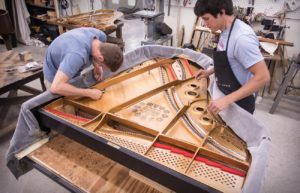
Installing The Refinished Plate
Refinishing a Grand Piano Plate
At that place are several steps we take when refinishing a vintage pianoforte's plate. The original finish is first removed and the plate is carefully hand sanded. Removing the original finish is a procedure that is very labor-intensive and takes a practiced bargain of time. After the plate has been sanded and carefully cleaned, whatsoever casting imperfections or other voids are puttied. This creates a smoother surface for the new cease. Once the primer has been applied, lacquer or polyurethane mixed with statuary flake powder is sprayed in multiple coats over the raw piece of bandage iron. Afterwards the finish has dried, the raised lettering is detailed by one of our artisans. A articulate coat of lacquer is then sprayed over the entire plate. This protects the finish and creates the desired level of sheen. For more almost our pianoforte restoration methods, click here.
Source: https://www.chuppspianos.com/services/grand-piano-parts/plate/
0 Response to "Do Grand Pianos and Baby Grand Pianos Have a Brass Plate Inside"
Post a Comment